
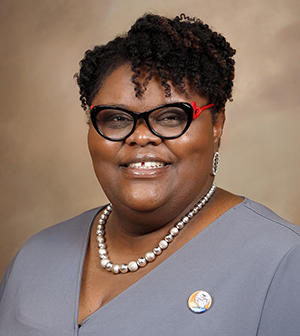
Dr. Sabrina Walthall is a professor at Mercer University and chair of its Department of Science. In addition to serving as a Fulbright Specialist, Sabrina is passionate about encouraging women in STEM and has special interest in anatomy and physiology and microbiology. She’s been using Carolina’s distance learning kits since 2019.
What roles have you taken on as an educator?
My first role as an educator has been a professor. I started here at Mercer University in 2009 as an assistant professor and since then have moved through the ranks to a full professor. In that role as a full professor, I have also been a program coordinator for our science program. That has led me to be the person who moved us from being in a space of face-to-face to online.
That led me truly to look at Carolina digital products when we were doing that transition. Now, I am the chair of the science department here and I oversee all of the changes that we make within the program. I can say that Carolina has followed me along this journey.
What’s the most fulfilling part of your work?
Students getting the understanding that they need. I saw the value and still see the value in the labs and how they really help a student make the connection from the lecture and help them understand exactly what they’re learning.
When you were a student, what would have made a great impact on your learning outcome?
I think the best thing that would have helped me with my learning outcome was something that I’m still trying to implement: open labs in the biology section.
We had open labs in the chemistry section when I was in college, but over in the biology section, we did not allow that. Now as an educator, I understand why, because the cost of things is a lot. I think having specimens that are in various stages of dissection that the student can come in and review and look over really would help.
What’s a breakthrough moment that you had while teaching online that changed how you approach distance learning?
The breakthrough moment, I think for all of us, was COVID. What was really great is that I began to work with Carolina Distance Learning in 2019. We were already in the works to soft pilot Carolina’s digital products. Then COVID happened, and everybody was taking this big, deep breath pause and I was like, ‘Oh, my God, we’re already there. We are packed right.’
There were so many things going on, and it allowed me to pare back and see in the next stage what I really needed to offer a student and how compassionate I needed to be with instructions so that they could be successful. That started me to have us have videos that went along with the product. Not just Carolina’s videos, but our individual videos based upon things that I saw the student need.
What advice would you give to a first-time distance learning instructor preparing for a new semester?
Remind yourself of where you were at some point in your learning and have empathy for students, because when you’re at home by yourself, it’s very hard to move through a dissection if you’ve never dissected before. Take some time to do introductory videos.
What’s your favorite hands-on lab activity that you’ve taught online, and why do you think it resonates with students?
My favorite one is the skeletal lab, because I use the skeletal lab for an oral practicum. The students have that skeleton and have the musculoskeletal lab that they walk through, but I took it a step further: you have to Zoom in with me, and I call out names of bones and you have to point to the bones.
I found that this makes the learning process even richer, because the students now know that they have to see me in order to do that lab. They really need to know the bones. What I’ve liked so much, especially since students have really gotten into it, is that they name and dress up the skeleton. I’ve found them with fingernails, eyelashes, baseball caps.
What do you think your students are going to need as technology advances and classrooms change in the future?
The big thing is artificial intelligence. It is also having the skills to use AI. That’s one of the things that I’m working with—grappling with—is how do I up-skill the student to be able to use AI to help them.
One of the ways that I’ve started and think students need to think about is, just like the skeleton becomes the person you study with, AI should also become your study partner. You should be able to have it give you a quiz, give you an assessment on a particular topic. What I found is that students study at what I call surface level. I think that’s where AI would definitely be enriching to the student experience.
What is one of the best ways you’ve found to connect with your students both in the classroom and online?
I crack jokes all the time, even in my lectures. But really the way that I like to connect with my students is videos. I think those are very important for face-to-face as well as online. I record lectures so that students can listen to them at all times. I’ve had students tell me that their kids listen with them as they’re driving from school.
I do a lot of encouraging videos. Midweek I’ll say, ‘Hey, I know it’s been a tough week. We’re at hump day. Here are some things that you should have done by now and need to be completed by the end of the week.’